
Justice Surya Kant has been appointed as the 53rd Chief Justice of India, succeeding Justice Bhushan R Gavai. He will assume office on November 24 and serve until February 9, 2027.

Justice Surya Kant, who was elevated as a judge of the Supreme Court on May 24, 2019, would have a tenure of over 1.2 years as the CJI. He is due to retire on February 9, 2027.

Former Chief Justice of India B R Gavai set a new precedent by leaving the official Mercedes-Benz car for his successor Surya Kant after the latter's swearing-in ceremony.

He will hold the office till February 9, 2027.

Chief Justice of India (CJI) Surya Kant likened some unemployed youngsters to cockroaches, saying they become media, social media, and RTI activists and attack the system. The comments were made while hearing a petition from a lawyer seeking senior advocate designation.

Chief Justice of India Surya Kant issued a clarification on his 'parasites' remarks, stating that he was misquoted by the media and that his comments were directed at individuals entering the legal profession with fake degrees, not the youth of the nation.
Chief Justice of India, Justice Surya Kant, advocates for careful integration of AI in the judicial system, emphasising the importance of human judgement and oversight in delivering justice.

Chief Justice of India, Justice Surya Kant, advocates for the integration of Artificial Intelligence (AI) into the judicial system, emphasising that it should enhance efficiency without compromising core judicial functions and human oversight.
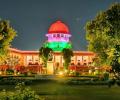
The Supreme Court has initiated suo motu action regarding an NCERT class 8 textbook that references corruption in the judiciary, raising concerns about potential defamation and the integrity of the judicial system.

The Supreme Court has allowed former West Bengal chief minister Mamata Banerjee and others to file fresh applications regarding their claim that victory margins were less than the deletion of votes during the Special Intensive Revision of electoral rolls.
The Supreme Court has declined the Centre's request to postpone the hearing on petitions challenging the constitutional validity of the 2023 law, which excludes the CJI from the committee responsible for appointing election commissioners, stating the matter is of utmost importance.
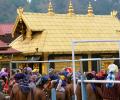
The Supreme Court is hearing petitions related to discrimination against women at religious places, including the Sabarimala temple. A nine-judge bench is examining the scope of religious freedom and the exclusion of women based on age and menstrual status.
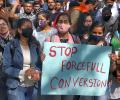
The Supreme Court has agreed to hear a plea challenging the validity of the Rajasthan Prohibition of Unlawful Conversion of Religion Act, 2025, potentially impacting religious freedom and state legislation.
The Supreme Court has directed all states and Union territories to provide comprehensive information on acid attack cases, including case status, victim details, and rehabilitation measures.
The Travancore Devaswom Board (TDB), managing the Sabarimala temple, argued in the Supreme Court that religious beliefs should be judged subjectively by the community, as the court hears petitions related to discrimination against women at religious places.
The Supreme Court has expressed disappointment over the delay in the Lakhimpur Kheri violence case trial due to the non-production of witnesses, directing the presiding judge to ensure their presence and expedite the proceedings.

The observations came from a bench of Chief Justice Surya Kant and Justice Joymalya Bagchi which was hearing pleas questioning the validity of Section 152 of the Bharatiya Nyaya Sanhita (BNS).
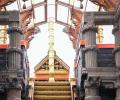
The Supreme Court observed that Hinduism is a way of life, stating that mandatory temple visits or rituals are not necessary to be considered a Hindu; even lighting a lamp at home suffices.

The Supreme Court has transferred the investigation of the Malda incident, involving the gherao and attack on judicial officers, to the National Investigation Agency (NIA), citing concerns about the credibility of West Bengal's bureaucracy.
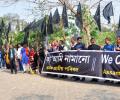
The Supreme Court has announced it will begin final hearings on May 5 regarding the constitutional validity of the Citizenship (Amendment) Act, 2019 (CAA), with over 200 petitions challenging the law.

The Supreme Court has taken suo motu action in the case of a brutal assault on a woman advocate in Delhi, allegedly by her husband, and has directed the Delhi Police Commissioner to hand over the investigation to a senior police officer.

The Supreme Court has dismissed a plea from a Dubai-based businessman seeking consolidation of 24 criminal cases against him, emphasising the need for a victim-centric judicial approach.
The Supreme Court has permitted the filing of a special investigation team (SIT) probe report before a Gurugram court regarding the rape of a three-year-old girl. The court is also considering the role of doctors and compensation for the victim.
The Supreme Court has expressed strong displeasure over statements made by politicians regarding the Shiv Sena symbol row case, cautioning them about making irresponsible comments.

The Supreme Court of India has dismissed the use of information from 'WhatsApp University' as evidence in a case concerning religious freedom and discrimination against women at religious sites, including the Sabarimala Temple.

The Supreme Court has taken exception to AIIMS' plea to set aside its order allowing a 15-year-old rape survivor to terminate her 30-week pregnancy, urging the Centre to amend the law to permit abortion beyond 20 weeks in such cases.

The Supreme Court has permitted the NIA to file its charge sheet upon completion of the investigation into the incident in West Bengal where judicial officers were illegally confined by a mob.
The Supreme Court has allowed former West Bengal chief minister Mamata Banerjee and others to file fresh applications regarding their claim that victory margins in 31 constituencies in the recent assembly polls were less than the deletion of votes during the Special Intensive Revision (SIR) of electoral rolls.

The integration of artificial AI-based judicial assistance tools into the district court management framework has accompanied the shift.
Supreme Court judge Justice B V Nagarathna has cautioned against the over-reliance on Artificial Intelligence (AI) in the judiciary, emphasising the need for judicial independence from algorithmic influence. She stressed that AI should only serve as a tool and not replace human judgement, which is guided by legal reasoning, constitutional values, and a deep sense of justice.
Supreme Court judge Justice B V Nagarathna stated that judicial independence in the modern era includes freedom from algorithmic influence, emphasising that AI should only assist judges, who must ultimately decide based on constitutional values and human judgment.

The Supreme Court has expressed concern over mining activities in the Aravalli hills and range, deferring any orders in favour of mining lease holders until it is fully satisfied with the environmental impact.
The Supreme Court of India has stated that religious institutions must have structure and norms for their functioning, emphasising that the right to manage a religious institution does not imply an absence of order.

Chief Justice of India Surya Kant has recused himself from hearing petitions challenging the constitutional validity of the 2023 law regarding the appointment of election commissioners, citing a potential conflict of interest.
The Supreme Court of India has agreed to examine a constitutional challenge regarding gender discrimination within Parsi personal law, specifically focusing on whether a Parsi woman loses her religious identity upon marrying outside the community.

The Madras High Court has restrained TVK MLA R Srinivasa Sethupathi from voting, including in the upcoming confidence motion, due to a petition challenging his one-vote victory.
Chief Justice of India Surya Kant cautioned against the uncritical adoption of AI in the judiciary, emphasising the need for human judgement and ethical considerations in judicial decision-making.
The Supreme Court has reserved its verdict on a petition challenging the Special Intensive Revision (SIR) of electoral rolls in Bihar, following arguments from various lawyers and the Election Commission of India.

The Supreme Court dismissed a petition related to the preliminary investigation report on the Air India plane crash in Ahmedabad, questioning the petitioner's motives and agenda.
The Supreme Court has requested the Delhi High Court to prioritise and expedite trials in cases of racial discrimination against people from the North-East, highlighting the need for a productive timeline for adjudication of such sensitive matters.
 © 2026 Rediff.com - Advertise with us - Disclaimer - Privacy Policy - Sitemap - Feedback - About us - Terms of use - Grievances